•

Crabbing on the Oregon Coast is an adventure that you have to experience to truly understand the addictive nature of this outdoor fishing sport. From the first time you pull your crab ring up out of the water, you immediately are hooked. Like fishing, crabbing is a sport for the outdoor enthusiast, however crabbing reaches out to the less technical side of catching dinner. From a fist time crabber, to a veteran crab ring fisherperson, there is equal opportunity for success. This page will show the techniques, equipment, and all necessary technical information about how to crab, when to crab, where to crab, about crabbing, the Dungeness crab himself, distinguishing gender, how to clean a crab, cook a crab, and yes even how to eat a crab. Read further about crabbing in Oregon on Nehalem Bay........
![]()
The Dungeness crab gets its name from the
Dungeness spit in Northern Washington where this crustacean was first
commercially harvested. It inhabits coastal sea beds from the low
inter-tidal zone such as Nehalem bay, to open ocean depths in excess of 600 feet!
The Dungeness life cycle begins with the mating season in May
/June,
then the eggs become fully fertilized and develop in a sponge-like mass,
protected under the females large "tail" and are hatched in a "larval" stage on
sandy beaches in the fall. Through the winter the larval crab grow and
develop, then hatch between January and March, and continue to grow and
molt repeatedly during its first two years, and after the second year a male
becomes sexually mature. It isn't until the crab reaches its third to fourth
year that is becomes legally available to keep for the sport crabber.
Commercial crabbers have larger size restrictions, thus the crab develop and
reproduce another year yet before they can be harvested. Females are
protected from harvesting to maintain the crab population as each female can
carry as much as 3 million eggs each year. The molting process in where a
crab grows into a larger shell, abandoning its old shell happens once each year
for adult crab, and takes 1-3 months before it can fill out that new shell.
Growth can be as much as 1 inch during this process. The Dungeness crab is a
scavenger, eating whatever meat it can, even its own. They are preyed upon
by many different creatures from the wolf eel to the octopus, even halibut feed
on the "Dungee".
Read further about crabbing in
Oregon on Nehalem Bay........
The sport Dungeness crab season in Oregon is year round for
tidal bays, estuaries and coastal rivers. The direct open ocean waters are closed from Aug. 15th to Nov. 30th. The best months
to go have nothing to do with a certain letter on the month, which direction the
wind is blowing, or even which color your grandpa's shorts are that day, but the
best months, weeks or days to go are determined by mother nature's
offering of rain and general bad weather.
A heavy sustained rain brings on an influx of freshwater to these estuaries,
causing the amount of salt in the water (salinity) to drop. Being salt water
creatures, crab pack up their things and head back out into the unaffected
waters of the deep ocean. General bad weather and storms will usually
prohibit the sport crabber from entering the ominous waters of these ocean
waters. On years when there have been light rains thru the fall and
winter, crabbing stays excellent throughout this time, however a heavy rainfall
and typical Oregon Coast weather will usually put a damper on any serious crab
catching. Calling us at Jetty Fishery before planning a crabbing trip
is usually a good idea during the fall thru spring months.
Read further about crabbing in Oregon on Nehalem Bay........
![]()
As of January, 2004 crabbing and clamming in Oregon requires a shellfish
license for those ages 14 and above.
This
license is available in either a full year, or a 3 day period, for in-state and
out of state residents. Check with us on the current prices. Although we
here at Jetty Fishery contested this legislation vehemently in 2003, it has
passed and is required. (Our political viewpoint will gladly be shared in
another forum). The sport crabbing regulations for size are a 5 ¾" across the
back of the shell, not including
the "points" which protrude from either side of the top shell. A crab measure
provided with a rental helps in a quick determination of whether it is a legal
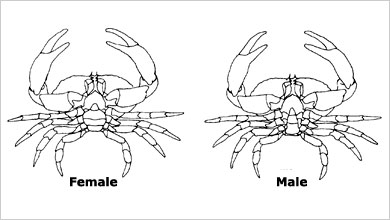
crab. Only male crab may be kept as well, and that is determined with a glance
on the underside of the shell. Male crabs have a thin "tail piece" where as the
female have a wide, round piece. Once you see the difference it is an easy sight
to tell the difference. A crabber may use 3 rings or pots to catch crab, and the
daily limit is 12 legal crabs per person. For further regulations, check out :
http://www.dfw.state.or.us/MRP/regulations/sport_fishing/
Read further about crabbing in Oregon on Nehalem Bay........
![]()
There are
many
ways to catch a crab, and many different devices used in catching crab.
the most widely used are by trapping the crab in crab pots, (also called traps)
and crab rings. Either of these are attached to a length of rope with a
flotation buoy on the opposite end of the rope. Your crabbing adventure
starts by placing your trap or ring in the water, with the rope leading to the
buoy floating on the surface, and then moving on to other locations to place the
remaining "gear" in the water. The most efficient means of sport crabbing
is with baited crab rings, which after a short wait of 5 to 7 minutes you return
to pull them up to check for legal sized male crab. Crabbing with
pots/traps allows for a longer wait, however there is the disadvantages of
letting the trapped crab demolish all you bait before you can determine if that
spot is good for catching "keepers". Here at Jetty Fishery our
"crabbing special" boat rental package comes packaged with 3 pre-baited crab
rings, bucket for your "keepers", measure to correctly determine the "keepers",
all necessary safety gear, and free boiling of the catch when you return.
There is also crabbing from our 200+ feet of ocean view floating dock, where
rings, light duty rings (for the young crabber), and "slip-rings" (for those who
have a bit of difficulty pulling rings fast) are available. Crab pots and traps
are not used in the dock area due to our friendly otter family who may get
caught in the entrances. A couple of other unique crab caching devices are the
crab snare and the Crab Hawk.
BELOW ARE: 1) CRAB RING
(BASKET) 2) CRAB POT (TRAP) 3) CRAB SNARE


![]()
Here at the Jetty Fishery the crab pot is always on, whether you are
bringing in your own catch to cook, or have decided just to stop by and purchase
some of our commercial crabs for sale. We boil our seafood in 100% pure
seawater, as it add the perfect compliment in bringing out the succulent flavors
that you can only experience with freshly caught seafood. Once cooked, the
cleaning of the crab is a simple process of removing t
he
shell, discarding the gills and viscera (guts). Remaining inside
the outer
shell is all delicious body and leg meat, hot fresh and ready to eat! There are
many other tips and tricks to enjoying fresh Dungeness crab as well as other
native shellfish that we have right here at Jetty Fishery. Stop by and take a
look at the wonderful world of live seafood. The tastes and experience is one of
a lifetime!
Read further about crabbing in
Oregon on Nehalem Bay........

Ask any of us here at Jetty Fishery and we will be the first to stand behind
our reputation as the # 1 marina you
will
find. Well as you might consider us a bit prejudice (we are) here are some
supporting facts: - The best in equipment: From the new Klamath boats, always
neat, cleaned, and ready to crab, to our crabbing rings that are checked daily,
there is a pride that we extend beyond ourselves what we rent. Location,
Location, Location: Jetty Fishery is nestled right on the the Nehalem Bay’s
ocean entrance, the Jetty has the closest proximity to
ocean
waters than any other marina. This translates into our position as being
virtually right on top of the action for crabbing, no 20-minute boat rides
before crabbing or fishing.
In
addition to great fishing and crabbing location, we have several different clam
beds easily accessible, beachcombing access, wildlife viewing, and spectacular
sunsets!
More often than not, you may stop at the Jetty fishery for the first time as a customer who appreciates the pleasant atmosphere and attentive service, but many find themselves coming back year after year, as our friends. Read further about crabbing in Oregon on Nehalem Bay........
![]()
Drew Carney, one of the dynamic reporters on the local KGW TV, (NBC) local morning show has become an adamant supporter our annual Crab Derby benefit, as well as a frequent customer of Jetty fishery.
This is the world record holder for hanging spoons on the face area. He won by successfully hanging 9 spoons at once, beating the record by one, and yet through all this fame and notoriety, he still comes and crabs with us here at Jetty Fishery!!
all content written exclusively by barrry je permission to excerpt must be obtained please contact: barryje@jettyfishery.com all photo's by: barry copyright properties of: jetty fishery
Questions or problems regarding this web site should be directed to barryje@jettyfishery.com 8-03-07..........Last modified